
What remains after the water goes
What remains after the water goes
A visit to flood-ravaged Uttargaya in Rasuwa left me thinking about dignity, loss and what it really means to rebuild after a disaster.
I recently travelled to Rasuwa, one of the districts severely affected by the 26 August 2026 Bhotekoshi flood, which caused significant loss of life, widespread displacement and extensive damage to homes, buildings, roads, bridges, hydropower facilities and other critical infrastructure along the river’s course in Nepal.
I travelled there representing Lumanti – Support Group for Shelter, together with our partner, the American Himalayan Foundation (AHF), which provided financial support for relief assistance to people affected by the flood. We were in Uttargaya Rural Municipality to assess the situation firsthand while supporting relief efforts for communities affected by the disaster.
What I saw was much more than what we had been seeing through photographs and videos on social media. The images and videos on social media had shown us the destruction and aftermath of the massive flood of 26 Aug 2026 in Nepal. But standing there, among the people who had lived through it, was something else entirely. It was not just the scale of the devastation that stayed with me. It was the way people were carrying it.
The people of Uttargaya seemed incredibly resilient. They were ready to volunteer, to help us, to show us around, as if nothing had happened to them. But as conversations unfolded, I slowly realized that almost no one we spoke to had been spared from the aftermath of the disaster.
“My father was swept away by the flood.”
“I lost my two sons. Now I am left with my wife and two daughters-in-law.”
“I am homeless now. I have nothing left. But thank God, all 11 members of my family are alive. I myself jumped out of the moving dozer I was working with.”
These were not dramatic statements. They were spoken almost matter-of-factly. And perhaps that was what affected me the most.
I had expected to see grief, anger and despair. Instead, I saw people who seemed to have accepted their own suffering in the context of everyone else’s. There was a strange sense of, I am not the only one who has suffered. Perhaps that was what helped them stand. And somehow, that was more painful for me than seeing their tears would have been.
We visited two holding centres. In the first, around fifty people, including infants, were living in just three rooms. There were a common cooking area and a common toilet, but no shower. When we arrived, another supporting agency was there taking measurements and discussing specifications to construct a common shower.
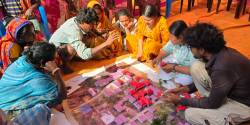
We had deliberately come with non-food items. We had been informed that food supplies were adequate, so instead we brought women, baby, and men hygiene kits, which included clothing and undergarments, mosquito nets, raincoats, bedsheets and other WASH-related items.
The response we received was deeply moving. One woman had been wearing the same pair of clothes since she was rescued from the flood, since last 22 days. It was not because clothes had not arrived as relief materials. Clothes had been distributed. But she was slightly larger in size, and none of the clothes that had arrived fitted her. It was such a simple thing, and yet it stayed with me.
We had brought maxi dresses and petticoats, along with three pairs of undergarments. I remember looking at the clothes and thinking that perhaps, for this woman, they would mean more than we could ever know.
In both holding centres, there were breastfeeding mothers and pregnant women. Our relief package also included baby kits, nappies and baby hygiene items. I was particularly glad that we had thought of those things.
In the middle of a disaster, it is easy to think about food, shelter and water, and of course, those are essential. But there are also the very ordinary things that make someone feel human, clean clothes, underwear that fits, a nappy for a baby, a place to wash, something to sleep on. Sometimes dignity comes in very small packages.
During our visit, we also met with a school in Kalikasthan. As we spoke with the teachers, one of them shared a story about a colleague who had lost everything in the flood.
“Our colleague, a teacher, lost everything. We supported him with the rent, cooking gas and a burner. He has already resumed his duty.” I remember that sentence. He has already resumed his duty.
There was no long explanation, no dramatic account of what the teacher had lost. Just the simple fact that he had lost everything, his colleagues had helped him with some of the most basic things he needed to start again, and he had returned to school.
Perhaps that is what resilience looks like too. A teacher returning to his classroom.
A colleague making sure there is gas to cook with. A community quietly helping one of its own get back on his feet. In the midst of everything that had been lost, life was already trying to find its way back.
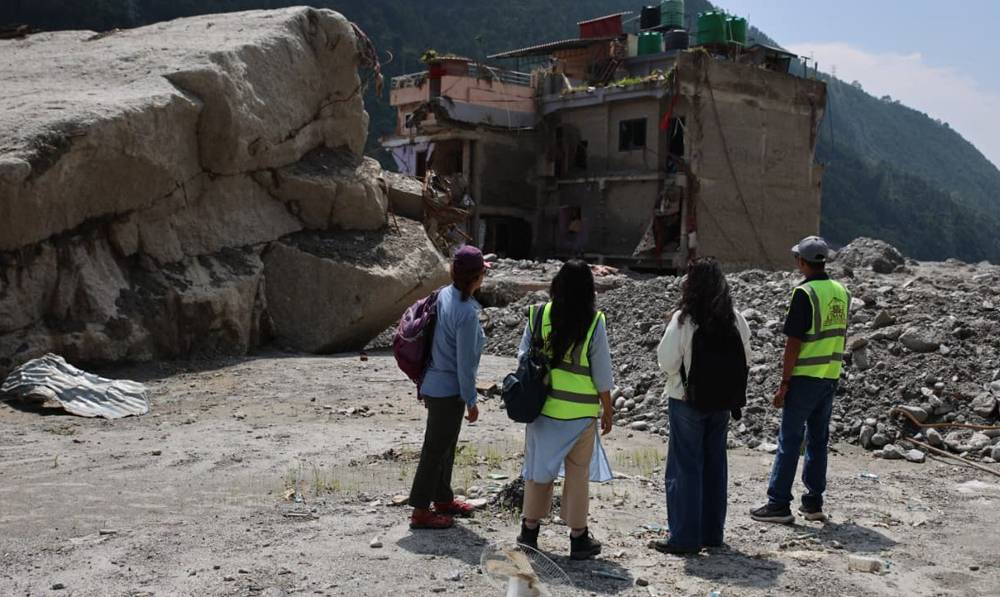
Then we went to the Betrawati River. Until that moment, I had been listening to stories about the disaster. Here, I saw it.
The house from which a 65-year-old woman had been rescued, the same house that had gone viral in the media, was still standing, or floating, submerged, looked like screaming for help.
The surroundings had an eerie smell. I had goosebumps.
Amid the wreckage, I noticed a single baby slipper. Nearby, there was a muddy teddy bear, that made me wonder what might have happened to those children, how they must have screamed for help, looked for their parents to come and save them. Or did they even get a chance to ask for help. So many thoughts that I couldn't push away.
And then I saw the wreckage of a school bus. I immediately wondered about the children who might have been inside. That thought was difficult to shake.
Important malpot documents, papers that had once represented land, property and ownership, were scattered along the newly formed deserted unlivable area created by the flood. They were everywhere, but now they seemed almost meaningless. What value do those papers have when the homes and lives they represented are gone?
Houses were almost upside down. People who knew the area pointed towards the wreckage and told us stories.
“Twenty-five dead bodies were taken out from there. It used to be a grocery mart.”
Then they pointed towards another half-submerged house.
“The old man from that house comes here every day. He begs us to let him look for his wife. He says she is still there.”
I did not know what to say. There were moments when words simply stop working.
The scale of what had happened was almost impossible to comprehend. You stand there looking at the river, the broken houses, the scattered belongings, and you keep thinking, how could something like this happen?
During the visit, we also spoke to a woman who had lost 43 members of her extended family, her husband, parents, daughter and son-in-law, nephews and nieces, uncles, cousins and other relatives.
She had already experienced devastating loss once. During the 2015 earthquake, she had lost her house and property. Then came the flood. This time, she lost almost everything she owned, and, much more painfully, so many of the people she loved. She is now left with her teenage son and her 24 year old daughter.
When I looked at her, I felt as though a smile had been taken away from her face. But she was not broken. She was about to leave to attend a ritual for her loved ones when we met her. Yet she still gave us time to talk. She told us that she could accept losing her property. Property could be rebuilt. A house could be built again. But how do you rebuild a family? That was the question that made all of us silent. She was deeply hurt by the loss of the people she could never bring back. She had lost 43 members of her extended family, losses from which, she said, there was no recovery or repair.
And yet, despite everything she had lost, she was leading a group of around 75 families who had also lost their homes and property, helping them think about resettlement.
I found myself wondering where people find that strength. Perhaps resilience is not the absence of pain. Perhaps it is learning to carry pain while still making room for someone else's.
Then there was also a moment during the visit when I felt a deep sense of pride. I was proud to be associated with Lumanti. Lumanti was well known in the area and deeply appreciated by the community. The organisation had been working in Kalikasthan and Uttargaya in Rasuwa after the earthquake and had built 382 shelters for earthquake survivors.
But what touched me even more was that Lumanti's work had not ended when the houses were built. The women's groups and cooperatives that Lumanti had helped establish were still functioning. We met two women who spoke with such gratitude about the knowledge and skills they had received through Lumanti. Years had passed, but they still remembered.
Standing there, I thought about how quietly Lumanti works. It does not always talk about the changes it has helped create. It does not always blow its own trumpet. It simply keeps working.
And now, once again, Lumanti is planning to support communities in rebuilding and resettling as much as it can. In fact, it is what is needed most right now, not just simply a roof over someone's head, but a place where people can feel safe, comfortable and dignified. And that is what the community was asking for too. Not just a shelter. A place that they can call their home.
I went to Rasuwa thinking I was going there to assess needs and support relief. I came back carrying something much heavier. I came back thinking about the woman who had no clothes that fit her. About the baby slipper lying alone in the mud. About the teddy bear.
About the school bus. About the old man who still comes every day looking for his wife. About the teacher who lost everything but had already returned to his classroom. About the woman who lost 43 members of her family and was still helping 75 other families find a way forward. And about the people who told us, almost casually, that their fathers, sons, husbands and relatives had been swept away. They did not ask for pity. They were already helping one another.
Perhaps what they need, and what we all need to remember, is that relief is not only about distributing things after a disaster. It is about restoring dignity, rebuilding trust, listening to people, and standing beside them for as long as it takes to rebuild what can be rebuilt.
Houses can be rebuilt. Communities can be rebuilt. Livelihoods can be rebuilt. But some losses cannot. And perhaps the least we can do is make sure that those losses are not forgotten.
- Samira Shakya
(Programme Manager with the Freshwater Action Network South Asia (FANSA) Regional Secretariat, working on water, sanitation and hygiene (WASH), social inclusion and community-led approaches. She has more than two decades of experience working in development, humanitarian response, advocacy and community development in South Asia and beyond. She is based in Kathmandu.)
News & Events
Share News:
-
Call Us
-
Email
-
Address